Canadian Payroll Deductions: A Complete 2026 Guide
Complete 2026 guide to Canadian payroll deductions with CPP, CPP2, EI rates and quick-reference table. Updated March 2026 with year-over-year changes.
The Canada Revenue Agency processed over $4.7 billion in payroll penalties and interest last fiscal year. Most of that wasn’t from companies trying to cheat. It was from companies that got the math wrong.
Canadian payroll deductions change every January. New ceilings, new rates, new rules. CPP2 is only in its second year and already tripping up experienced payroll teams. The numbers shift quietly, but the penalties for missing them land on the employer. Not the employee. Not the accountant. Not the software vendor. You.
This guide covers every mandatory deduction for 2026, the thresholds that changed this year, and the five mistakes that cost Canadian employers the most money.
Payroll deductions calculated automatically, every pay run
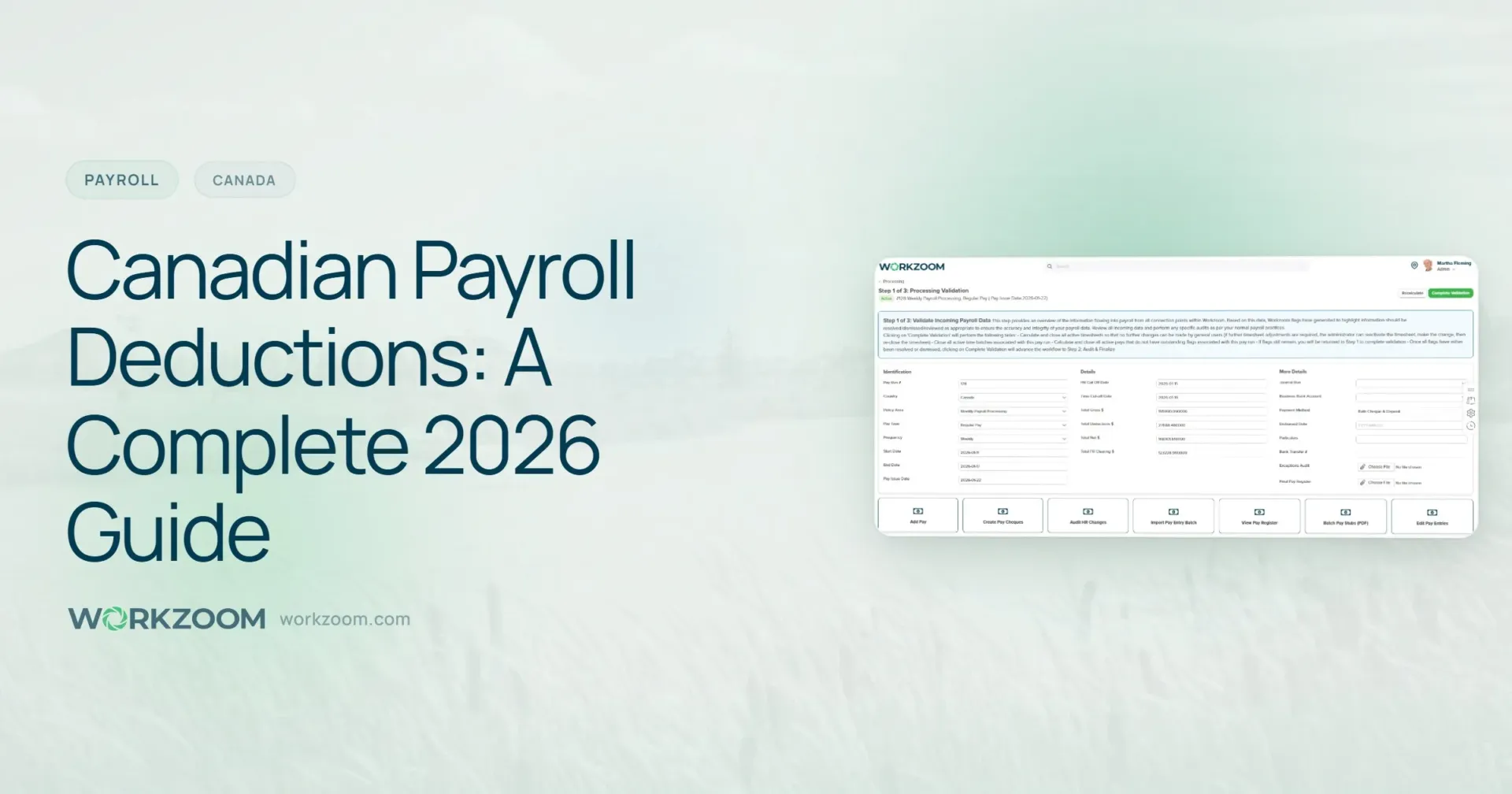
Workzoom’s payroll engine handles CPP, CPP2, EI, and federal/provincial tax across every Canadian jurisdiction. $4/employee/month, no implementation fees, month-to-month.
2026 Canadian Payroll Deductions: Quick Reference Table
Every rate and threshold in one place. Bookmark this table and come back to it each pay period.
| Deduction | Rate (Employee) | Rate (Employer) | Maximum Earnings | Max Annual Contribution |
|---|---|---|---|---|
| CPP | 5.95% | 5.95% | $74,600 | $4,230.45 |
| CPP2 | 4.00% | 4.00% | $85,000 (2nd ceiling) | $416.00 |
| QPP (Quebec) | 6.40% | 6.40% | $74,600 | $4,550.40 |
| EI | 1.63% | 2.282% | $68,900 | $1,123.07 (ee) / $1,572.30 (er) |
| EI (Quebec) | 1.31% | 1.834% | $68,900 | $902.59 (ee) |
| QPIP (Quebec) | 0.494% | 0.692% | $98,000 | $484.12 (ee) |
What Changed in 2026 vs 2025
If you updated your payroll in January, verify these specific changes landed correctly:
- Federal basic personal amount: Increased from $16,129 to $16,452 (+2%)
- CPP first ceiling: Up from $71,300 to $74,600 (+4.6%)
- CPP2 second ceiling: Up from $81,200 to $85,000 (+4.7%)
- EI maximum insurable earnings: Up from $65,700 to $68,900 (+4.9%)
- Federal lowest bracket rate: Dropped from 15% to 14% (first reduction in 25 years)
- EI premium rate: Down slightly from 1.64% to 1.63%
The CPP2 ceiling increase is the one most likely to be missed. If your payroll system hardcoded the 2025 ceiling of $81,200 instead of pulling the updated $85,000, employees earning between $81,200 and $85,000 are being under-deducted right now.
The Three Mandatory Deductions Every Canadian Employer Must Withhold
Every employee paycheque in Canada has three non-negotiable deductions. Miss any one of them and the CRA comes looking. Not at your employee. At you.
1. Canada Pension Plan (CPP/QPP)
CPP applies to every employee aged 18 to 69 earning above the basic exemption. Here are the 2026 numbers:
- Basic exemption: $3,500 (unchanged)
- Maximum pensionable earnings (first ceiling): $74,600
- Employee contribution rate: 5.95%
- Employer contribution rate: 5.95% (you match dollar for dollar)
- Maximum annual employee contribution: $4,230.45
Quebec employees contribute to the Quebec Pension Plan instead, at a higher rate of 6.40%. If you have staff in Quebec, this is a separate calculation, not a simple swap.
CPP is not optional. Between 18 and 65, you must deduct it. Between 65 and 70, the employee can elect to stop contributing, but only by filing a CPT30 form. No form on file means no exception.
2. CPP2: The Second Ceiling (Year Two)
CPP2 is still catching payroll teams off guard. Introduced in 2024, it adds a second earnings ceiling above the standard CPP maximum. The 2026 numbers:
- Second ceiling: $85,000
- CPP2 contribution rate: 4.00% (on earnings between $74,600 and $85,000)
- Maximum annual CPP2 employee contribution: $416.00
Here’s what catches people. CPP2 only kicks in after an employee maxes out their regular CPP contributions. If your payroll system treats it as a simple rate increase instead of a separate second-ceiling calculation, your deductions will be wrong for every employee earning between $74,600 and $85,000.
3. Employment Insurance (EI)
EI premiums apply to almost every employee in insurable employment. The 2026 numbers:
- Maximum insurable earnings: $68,900
- Employee premium rate: 1.63%
- Employer premium rate: 2.282% (1.4x the employee rate)
- Maximum annual employee premium: $1,123.07
Quebec employees pay a reduced EI rate because QPIP covers parental benefits separately. This means you need different EI calculations depending on which province your employee works in. Not where your company is headquartered.
The most common EI mistake isn’t the rate. It’s the classification. Misclassifying an employee as an independent contractor means zero EI deductions, and the CRA will reassess you retroactively for the full employer portion plus penalties.
Federal and Provincial Income Tax
Beyond CPP and EI, you’re responsible for withholding income tax at source. This is where it gets layered, because every employee owes both a federal and provincial amount, and the rates differ by jurisdiction.
Federal Tax Brackets for 2026
Federal brackets are indexed to inflation each year, and 2026 brought a significant change: the lowest bracket rate dropped from 15% to 14%. Here are the current brackets:
- 14% on the first $58,523
- 20.5% on $58,523 to $117,045
- 26% on $117,045 to $181,440
- 29% on $181,440 to $258,482
- 33% on income over $258,482
The basic personal amount for 2026 is $16,452 for employees earning up to $181,440. Above that, it claws back to $14,829 at incomes over $258,482. This number changes annually, and your payroll system needs to pick it up automatically. Otherwise you’ll over-withhold from January straight through to December.
Provincial Tax: The Part That Varies Wildly
Provincial tax rates range from about 4% in the lowest brackets (Nunavut) to over 20% in the highest (Nova Scotia). Every province has its own basic personal amount, its own brackets, and its own surtaxes.
For a company with employees in Ontario, Alberta, and B.C., you’re running three different provincial tax calculations on top of the federal one. Every single pay period.
The province of employment determines which provincial tax rate applies. Not the province where the employee lives, and not where your head office is. If someone works remotely from Nova Scotia for your Toronto company, you withhold Nova Scotia provincial tax.
Employer-Only Costs You Can’t Forget
Deductions from the employee’s paycheque are only half the picture. Employers also owe amounts that never show up on the pay stub but absolutely show up on your remittance.
Employer CPP Match
You pay the same CPP amount as your employee. For someone earning above the first ceiling, that’s $4,230.45 in employer CPP plus up to $416.00 in employer CPP2. That adds up to $4,646.45 per employee in pension costs alone, before you’ve paid a dollar of salary.
Employer EI Premium
Your EI contribution is 1.4 times what the employee pays. Maximum employer EI premium for 2026: $1,572.30 per employee.
Workers’ Compensation
Every province runs its own workers’ compensation board (WSIB in Ontario, WorkSafeBC in B.C., WCB in Alberta). Rates vary by industry classification. A professional services firm might pay $0.18 per $100 of insurable earnings. A construction company might pay $3.50 or more.
Employer Health Tax (Ontario, B.C., Manitoba, Newfoundland)
Ontario’s Employer Health Tax is the one that surprises people. If your Ontario payroll exceeds $1 million, you’re paying up to 1.95% of total payroll as a provincial health tax. B.C., Manitoba, and Newfoundland have similar levies.
Total Employer Cost Per Employee: 2026 Summary
| Cost Component | Amount (for $75,000 salary in Ontario) |
|---|---|
| CPP employer match | $4,230.45 |
| CPP2 employer match | $16.00 |
| EI employer premium | $1,572.30 |
| Ontario WSIB (Class G, ~$0.36/$100) | $270.00 |
| Ontario EHT (< $1M payroll exempt) | $0.00 |
| Total employer-side cost | $6,088.75 |
For a company with 250 employees at an average salary of $75,000, that’s roughly $1.52 million in employer-side payroll costs on top of $18.75 million in salaries. These costs are non-negotiable and increase every year with CRA rate adjustments.
Remittance Deadlines and Penalties
Withholding the right amounts is step one. Getting them to the CRA on time is step two. And step two has teeth.
Remittance Frequencies
How often you remit depends on your average monthly withholdings (AMWA):
- Regular remitter (AMWA under $25,000): Due by the 15th of the following month
- Threshold 1 accelerated (AMWA $25,000 to $99,999): Twice monthly. By the 25th for the first 15 days, by the 10th of the next month for the rest.
- Threshold 2 accelerated (AMWA $100,000+): Up to four times per month. Within 3 business days of each pay date.
Miss a deadline and you’ll pay a penalty of 3% for amounts 1-3 days late, climbing to 10% for anything more than 7 days late. Repeat offenders face 20%. The CRA charges compound daily interest on top.
Late remittance penalties are assessed per occurrence, not per year. A company that misses four deadlines doesn’t get one penalty. It gets four.
Year-End Obligations: T4s, RL-1s, and the February Deadline
At the end of each calendar year, you need to produce a T4 slip for every employee you paid. Quebec employers also need RL-1 slips. The filing deadline is the last day of February.
Every T4 must reconcile with your actual remittances. If you withheld $50,000 in CPP across all employees but only remitted $48,000, the CRA will send a balance-due notice plus interest dating back to when the shortfall first occurred.
Common T4 errors that trigger CRA reviews:
- Taxable benefit amounts missing from Box 14 (company car, group insurance premiums)
- CPP pensionable earnings that don’t match insurable earnings calculations
- RRSP room calculations that don’t align with reported earnings
- Missing or incorrect province of employment codes
Five Payroll Deduction Mistakes That Cost the Most
After 25 years of building payroll software for Canadian companies, we’ve seen every payroll error there is. These five show up the most, and they’re all preventable.
1. Not Updating CPP2 Logic
CPP2 is new enough that some payroll systems still don’t handle it correctly. If your system treats it as a CPP rate increase instead of a separate second-ceiling calculation, your deductions will be wrong for every employee in that earnings band.
2. Wrong Province of Employment for Remote Workers
Since 2020, remote work has made this exponentially worse. An employee who moved from Ontario to New Brunswick mid-year needs their provincial tax recalculated from their move date. Not from the next January.
3. Taxable Benefits Not Added to Earnings
Group life insurance premiums paid by the employer above $25,000 coverage, company vehicle personal use, employer-paid parking. These all need to be added to taxable income. Miss them and your T4s will be wrong, your CPP/EI calculations will be short, and the CRA will reassess.
4. EI Premium Reduction Not Applied
If your company offers a qualifying short-term disability plan, you may be eligible for a reduced EI premium rate. Many employers either don’t know this exists or don’t apply it correctly. The result: thousands more in EI premiums than necessary.
5. Missing Remittance Deadlines After Growing
This one is almost invisible until it hits. Your company grows from 100 to 200 employees, and your AMWA crosses the $25,000 threshold. Suddenly you’ve gone from monthly remittances to twice-monthly. Nobody changed the calendar. The CRA doesn’t send a reminder.
Most payroll penalties aren’t from intentional errors. They come from systems that didn’t update, processes that didn’t scale, and rules that changed without anyone noticing. The fix isn’t more diligence. It’s software that handles the updates automatically.
How to Stay Compliant Without Losing Your Mind
Canadian payroll compliance isn’t a set-it-and-forget-it operation. Rates change annually, rules change periodically, and your workforce changes constantly. Here’s the minimum you need:
- Payroll software that auto-updates rates. CPP, CPP2, EI, and tax brackets should update each January without manual intervention.
- Multi-province support. Not just the rates, but the employer health taxes, WCB classifications, and province-of-employment logic.
- Automated remittance tracking. Your system should know your remittance frequency and flag upcoming deadlines.
- Year-end T4/RL-1 generation with built-in reconciliation against your actual remittances. Not a separate export-and-pray process.
- Audit trail. The CRA can request payroll records going back six years, and “we changed systems” isn’t an acceptable excuse for missing data.
If your current system can’t do all five of those things natively, the system is the risk. Not the compliance rules.
Frequently Asked Questions
Stay in the loop
Canadian HR, payroll, and workforce insights. No spam.
You’re subscribed!
See What $4/Employee Gets You
One platform for HR, workforce, payroll, and talent. $4–$16/employee/month depending on which suites you need. No setup fees, no contracts.
More from the Blog